The WATERGRID project
Full project name: Nature Based Smart Water Grids for Integrated water and drought management (WATERGRID)
Duration: September 2025 – August 2029 (48 Months)
Project budget: € 7 945 771,25
EU contribution: € 7 549 383,13
Consortium: 22 organizations from 13 countries
As Europe faces more frequent and severe droughts, we need new ways to manage water.
WATERGRID’s mission is to strengthen today’s water systems by combining Nature-Based Solutions (NBS) with smart technology. We build and restore natural “water storage” areas—such as wetlands, floodplains, and ponds—and connect them through a digital monitoring network: the Nature-Based Smart Water Grid.
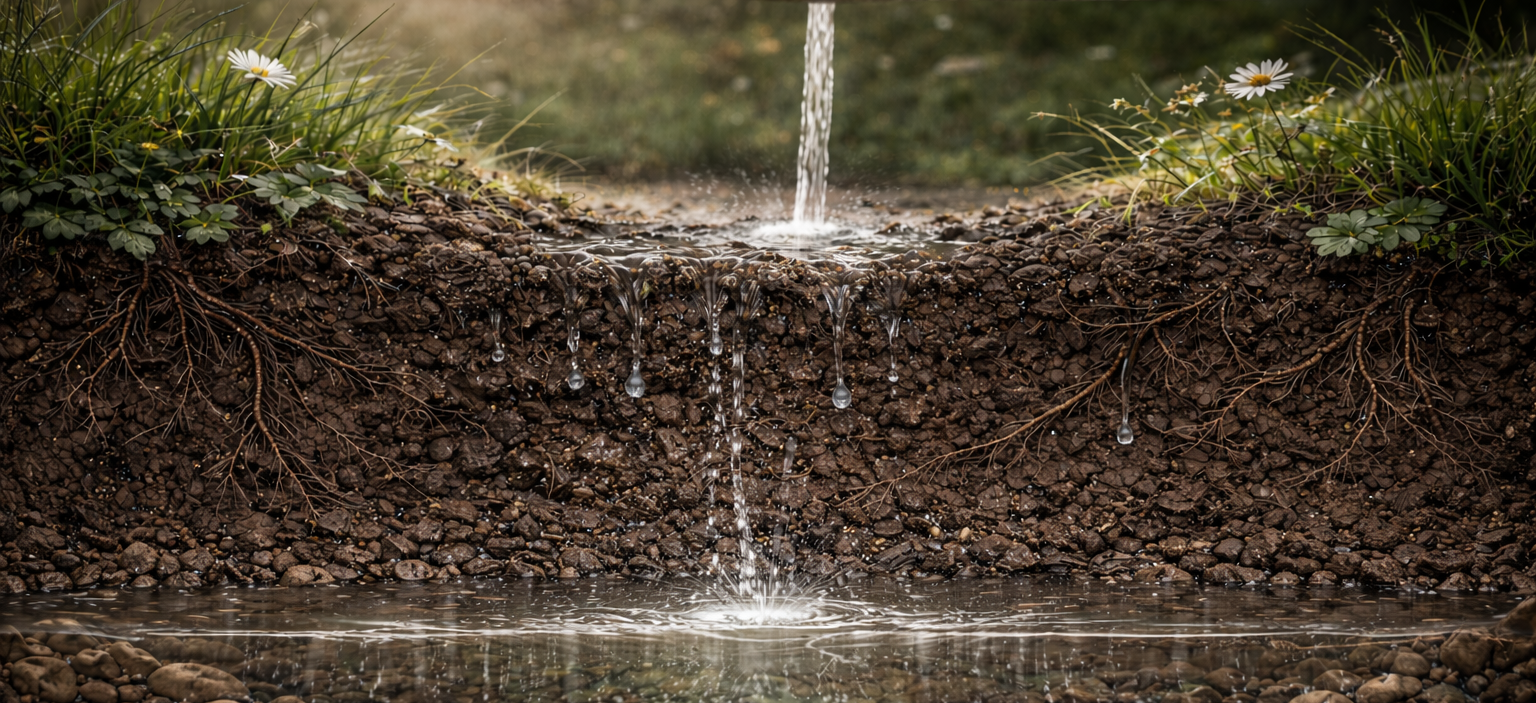
This blue-green infrastructure acts like a “water battery”: it slows water down, helps it soak into the ground and recharge groundwater, and keeps more water in the landscape. As a result, it can secure water supplies and increase drought resilience.
Beyond Water Management, Smart Water Grids are driving:
Climate Resilience: Preparing European regions for the extremes of tomorrow.
Water Quality: Using natural filtration to reduce pollution and nutrient pressures.
Economic Sustainability: Demonstrating that nature-integrated approaches offer significant long-term savings compared to purely “grey” infrastructure.
The WATERGRID project
Full project name: Nature Based Smart Water Grids for Integrated water and drought management (WATERGRID)
Duration: September 2025 – August 2029
(48 Months)
Project budget: € 7 945 771,25
EU contribution: € 7 549 383,13
Consortium: 22 organizations from 13 countries
As Europe faces more frequent and severe droughts, we need new ways to manage water.
WATERGRID’s mission is to strengthen today’s water systems by combining Nature-Based Solutions (NBS) with smart technology. We build and restore natural “water storage” areas—such as wetlands, floodplains, and ponds—and connect them through a digital monitoring network: the Nature-Based Smart Water Grid.
This blue-green infrastructure acts like a “water battery”: it slows water down, helps it soak into the ground and recharge groundwater, and keeps more water in the landscape. As a result, it can secure water supplies and increase drought resilience.
Beyond Water Management, Smart Water Grids are driving:
Climate Resilience: Preparing European regions for the extremes of tomorrow.
Water Quality: Using natural filtration to reduce pollution and nutrient pressures.
Economic Sustainability: Demonstrating that nature-integrated approaches offer significant long-term savings compared to purely “grey” infrastructure.
Our approach
A European Living Laboratory
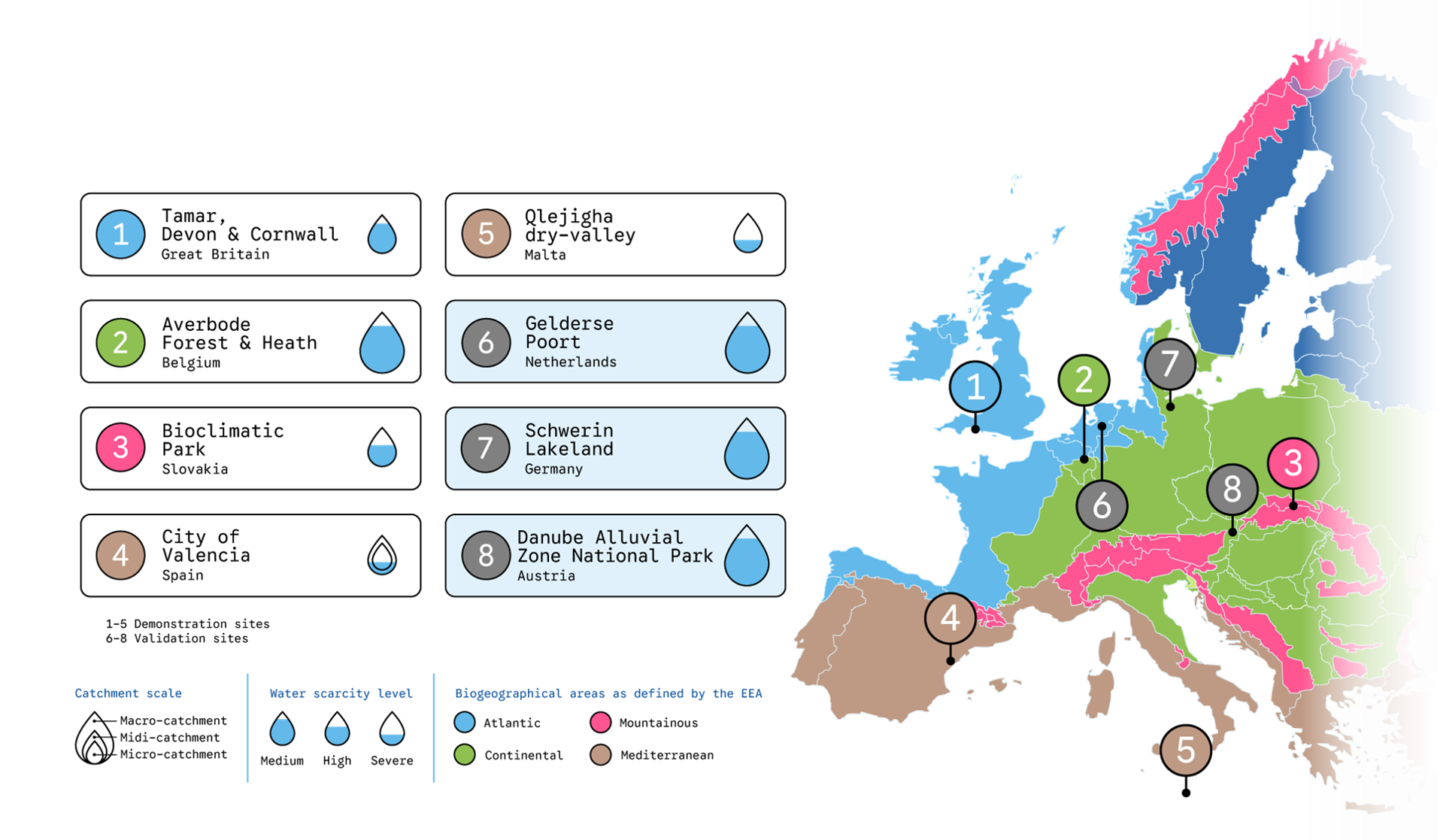
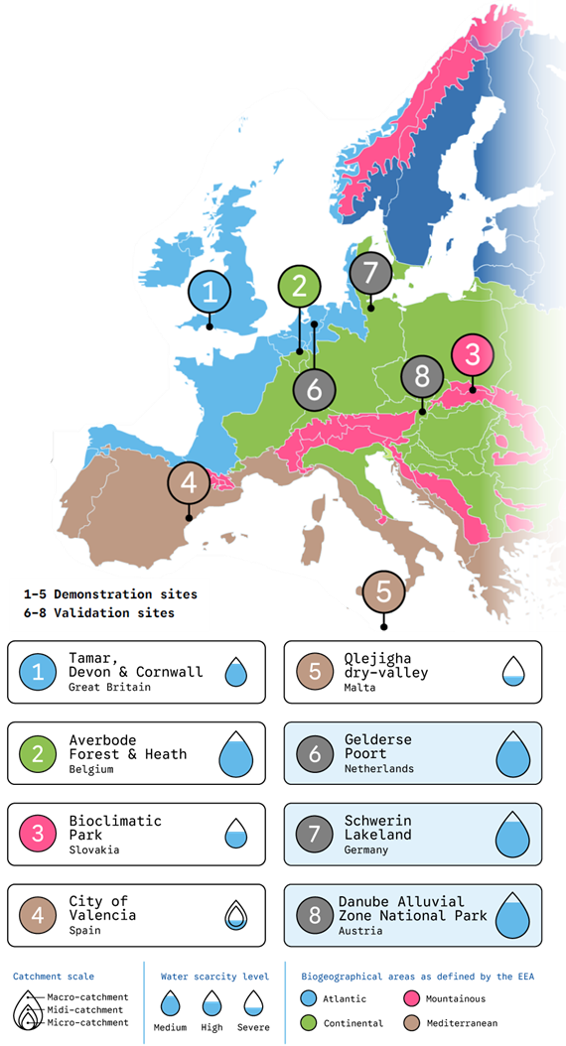
WATERGRID operates across 8 Demonstration and Validation Sites spanning four European biogeographical regions: Atlantic, Continental, Mountain, and Mediterranean. These regions differ in flora, fauna, environmental conditions, and degrees of water scarcity. By covering this diversity, WATERGRID ensures that Smart Water Grids can be tested under real conditions—and replicated across Europe.
These sites serve as our real-world laboratories. Together, they provide the necessary evidence to prove that Nature-Based Solutions (NBS) are not just “green ideas,” but high-performing, measurable components of a modern Smart Water Grid (SWG).
Our Five Core Objectives
In each laboratory, we work to operationalize the SWG concept to:
Slow, move, and store water more effectively
Reduce pollution and nutrient pressures
Enhance drought resilience
Support healthy ecosystems and sustainable water use
Provide real-world evidence for the SWG concept
Our approach
A European Living Laboratory
WATERGRID operates across 8 Demonstration and Validation Sites spanning four European biogeographical regions: Atlantic, Continental, Mountain, and Mediterranean. These regions differ in flora, fauna, environmental conditions, and degrees of water scarcity. By covering this diversity, WATERGRID ensures that Smart Water Grids can be tested under real conditions—and replicated across Europe.
These sites serve as our real-world laboratories. Together, they provide the necessary evidence to prove that Nature-Based Solutions (NBS) are not just “green ideas,” but high-performing, measurable components of a modern Smart Water Grid (SWG).
Our Five Core Objectives
In each laboratory, we work to operationalize the SWG concept to:
Slow, move, and store water more effectively
Reduce pollution and nutrient pressures
Enhance drought resilience
Support healthy ecosystems and sustainable water use
Provide real-world evidence for the SWG concept
The eight WATERGRID sites
At five Demonstration Sites, carefully designed and locally adapted Nature-Based Solutions (NBS) will be implemented to slow, move, and store water. By integrating these new interventions into a smart, monitored network—together with existing NBS—we will establish Smart Water Grids at each site, supported by digital tools for monitoring, maintenance, and decision-making.
To complement this, three Replication Sites will broaden the evidence base by applying the developed protocols and tools across diverse catchment scales, water scarcity levels, governance and management challenges, and socio-economic contexts Together, these sites will pave the way for future replication and catalyse the upscaling of SWGs.